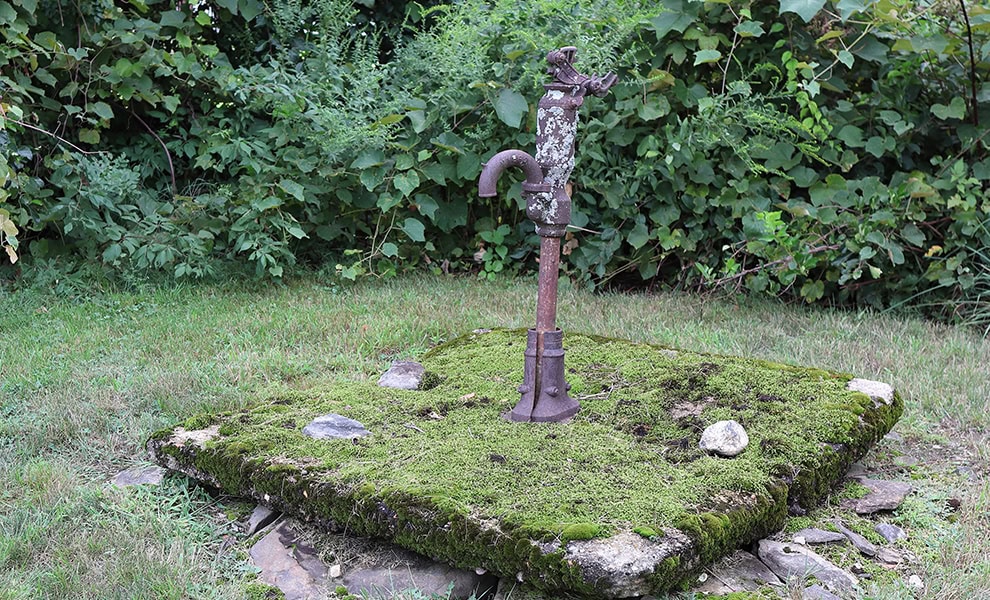
In the article Six ways ancient civilisations managed water without power, we look at some TEK water systems and technologies, like storing water in underground cisterns. This does, though, beg the question of how we move water when it suits us to where it suits us. If you have a well, for example, what’s a good low-tech way to access the water if a rope-and-bucket isn’t cutting it and you don’t want to resort to a motorised pump?
Long before electricity, people solved the problem of lifting or pushing water using nothing but leverage, rotation, and pressure. This article started life as a ‘how to make a pump’ piece, but there are so many approaches that depend on what kind of water you have access to and what you are doing with it that instead we decided to look at what some of those mechanisms are (photos at the bottom of the page).
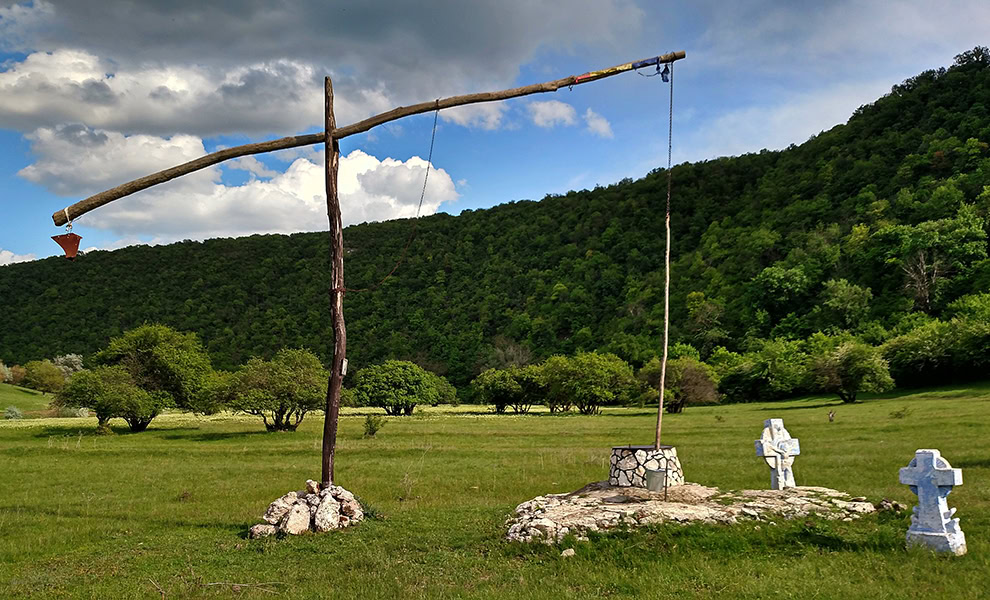
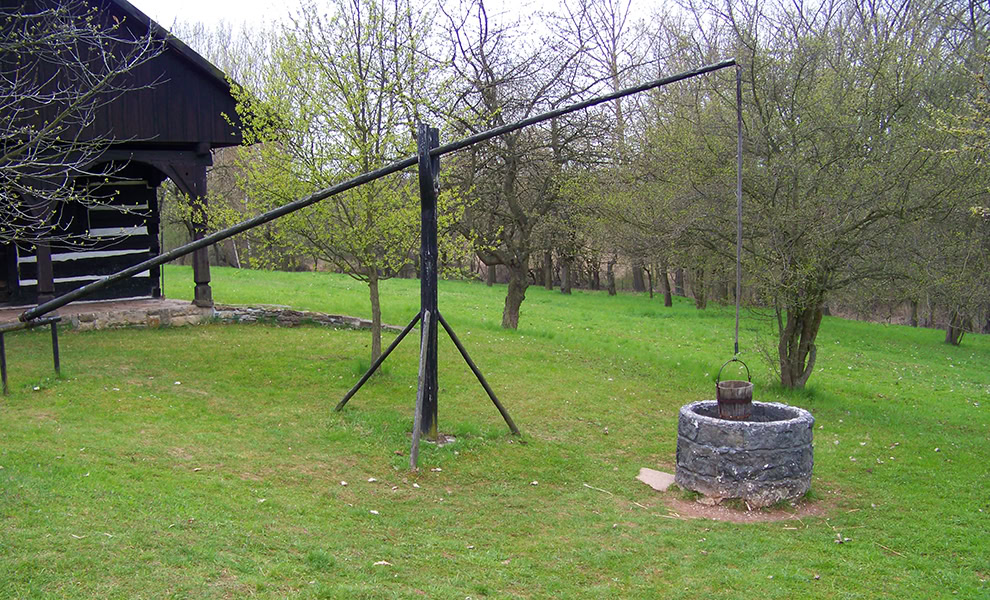
1. Shadoof: counterweighted lever for lifting water
- For lifting water from a well, basin, river, or canal – typically made from timber (pole and frame) and a clay or leather bucket.
The shadoof is a lever with a counterweight: a long pole pivots on a fulcrum, with a bucket at one end and a heavy weight at the other. Because the counterweight is doing most of the work, someone can pull the bucket down into the water with barely any effort, and, when they let go, the counterweight swings the loaded bucket back up on its own. The person operating a shadoof never lifts the water’s weight directly; the lever does that, and the operator is just there to guide the motion and tip the bucket out once it’s up. From Ancient Egypt and Mesopotamia, circa 3000 BCE.
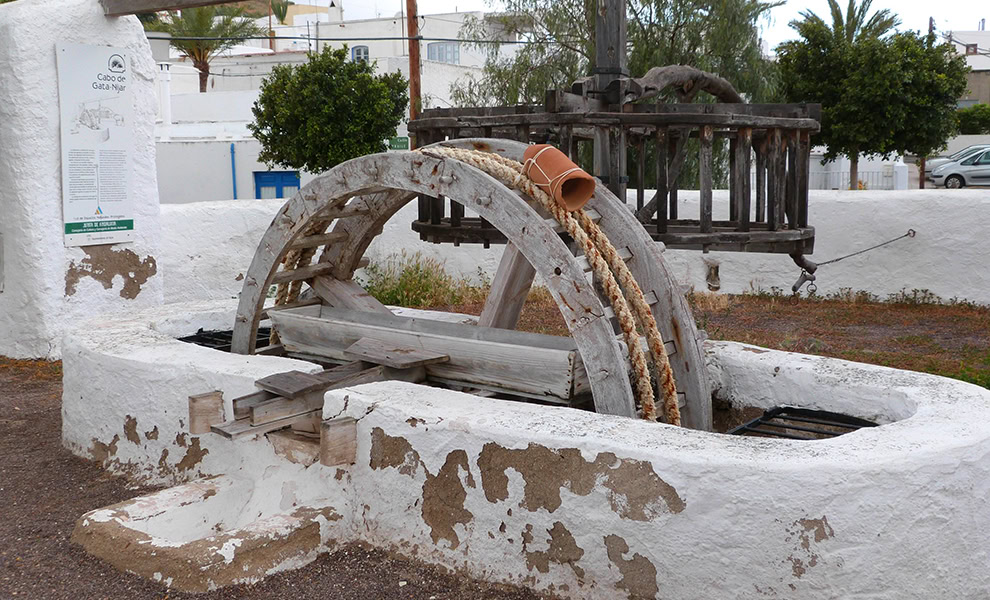
2. Saqiya (Persian wheel): animal-powered wheel of buckets
- For lifting water from wells or rivers into irrigation canals – typically a wooden wheel with clay or metal buckets and a metal axle.
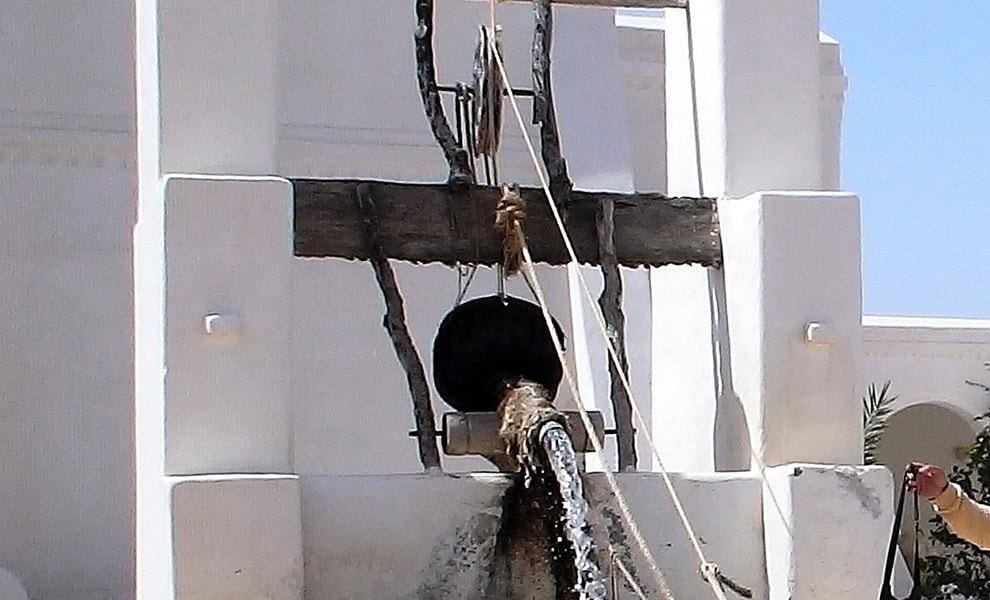
A saqiya is essentially a mechanised, continuous version of scooping water by hand. A vertical wheel with a string of pots attached around it is geared to a horizontal wheel turned by a person or animal (often an ox or donkey) walking in a circle. As the vertical wheel rotates, each pot in turn dips into the well or river it is positioned over, fills, rises with the wheel, and tips its contents into a trough at the top before heading back down empty. The gearing takes the animal’s steady circular walk and converts it into rotation of the water wheel, and because there are many pots working at once, the amount of water moved per hour is far higher than anything a single person could manage. A Persian wheel is not the same thing as a noria (detailed below), but the terms are sometimes used interchangeably. In Spanish, noria is the umbrella term for both types, with ‘de sangre’ (‘of blood’) added specifically to flag the animal-powered version. From Mesopotamia (1st millennium BCE), then India and Egypt.
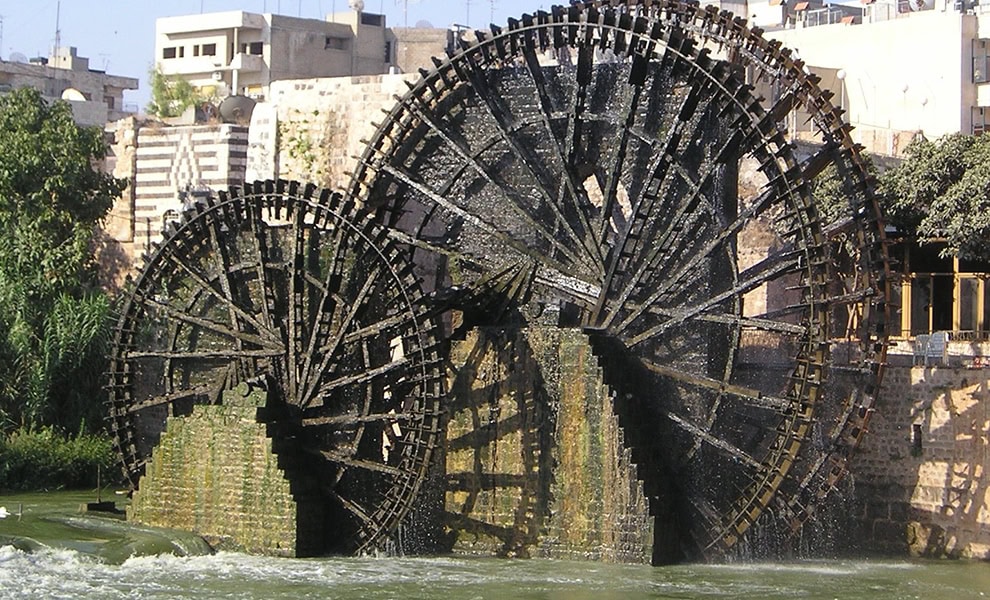
3. Noria: a river-powered wheel
- For lifting river water into aqueducts for irrigation or town water supply – typically a wooden wheel with clay buckets.
A noria needs no power except the river itself. A large wheel sits partly submerged in flowing water, with paddles or blades around its edge that catch the current and turn the wheel (unlike a Persian wheel, no animal or person needs to turn anything). Compartments or pots built into the wheel’s rim scoop up water as they pass through the river at the bottom, get carried up as the wheel turns, and empty out into a raised channel once they reach the top. A noria converts the river’s own energy of motion into lift, running for as long as the river keeps flowing with no ongoing labour. From Mesopotamia (1st millennium BCE), then widely adopted in Islamic Spain.
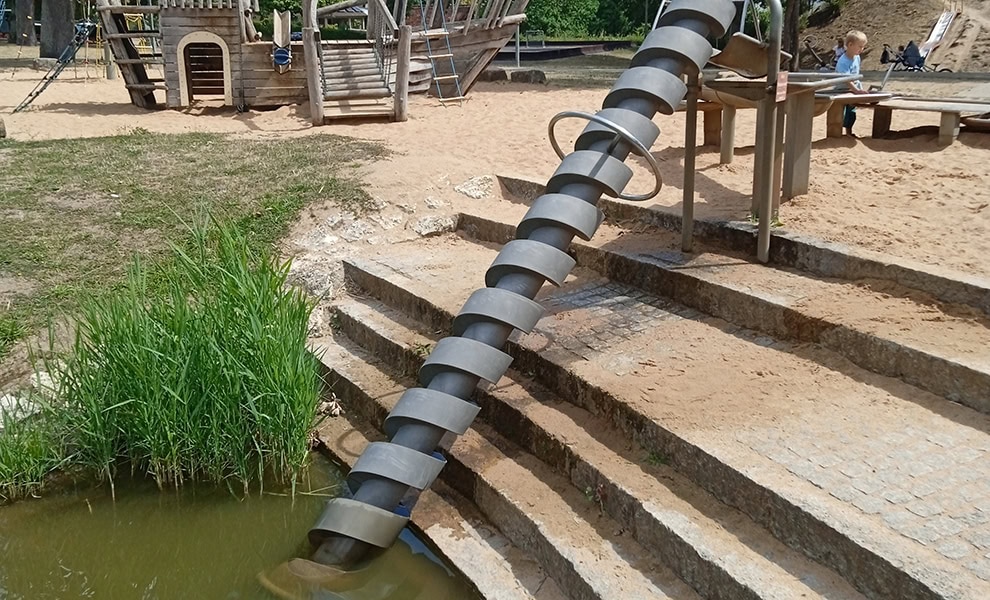
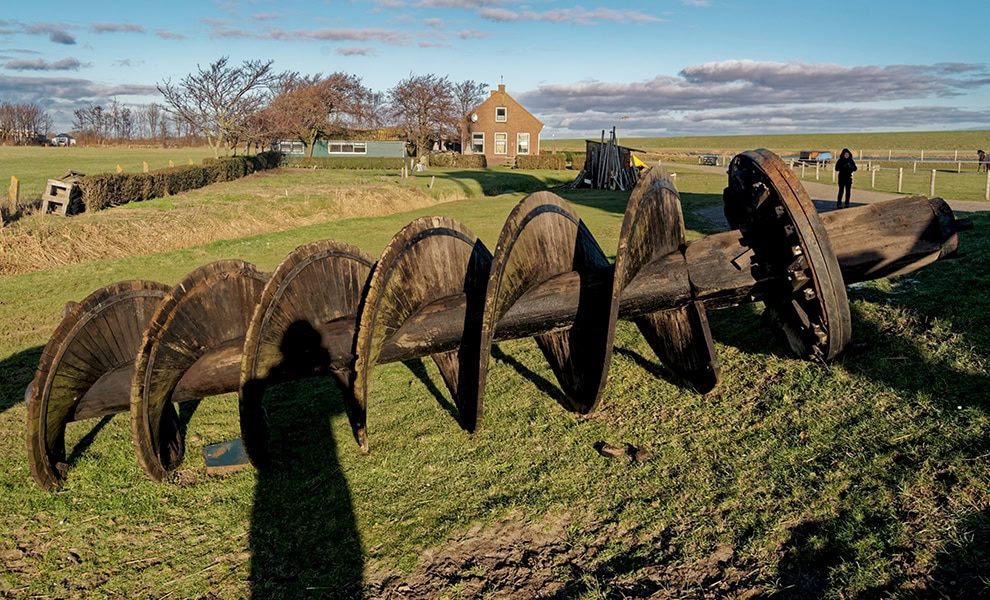
4. Archimedes’ screw: a rotating helicoid to lift water
- For moving water from rivers, wells, or low-lying canals to higher terraces or irrigation systems – typically a wooden or metal cylinder and screw.
An Archimedes’ screw works almost entirely on geometry, and the only moving part is the screw itself. A helicoidal blade sits snugly inside a tube, tilted at an angle with the bottom end placed in the water source. As the whole assembly turns, the helicoid effectively traps an amount of water between the blade and the cylinder wall, and because the spiral is angled, that water has nowhere to go except upwards with each rotation. As the screw keeps turning, the water keeps climbing the tube until it reaches the top and pours out. There is no valve or bucket – the shape of the screw does all the work. From Greece in the 3rd century BCE (credited to Archimedes).
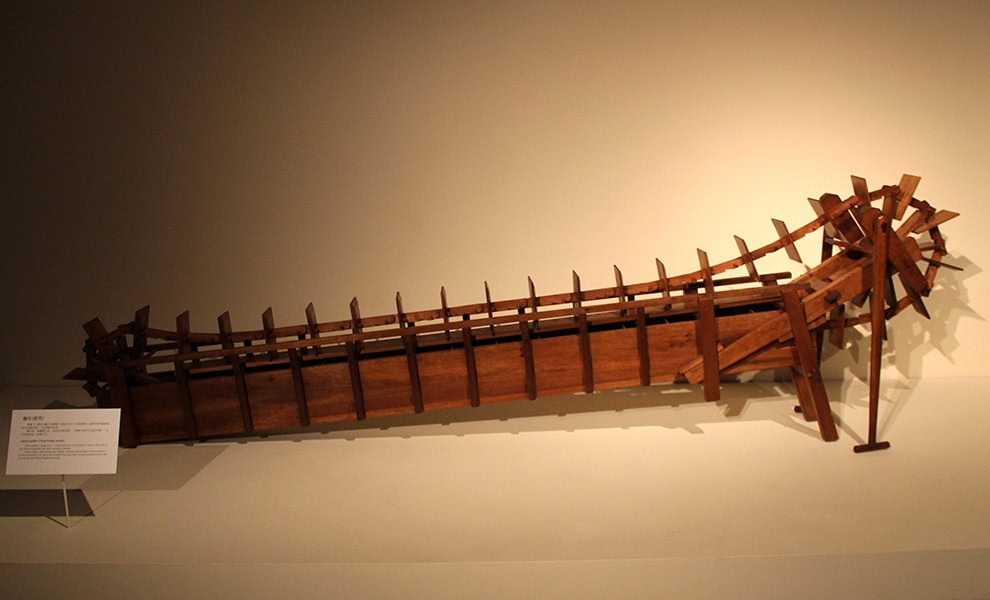
5. Chain pump: pushes water up a tube
- For irrigation, filling reservoirs, and feeding fountains – typically bamboo or wood scoops with rope or chain and a wooden frame (modern versions are often made of metal).
A chain pump is a loop of chain running between two wheels, one down at water level and one up at the point where you want the water delivered, with small discs or scoops fixed along the chain at intervals. The whole loop runs through a tube that fits it closely. When you turn the top wheel, the chain drags upward through that tube, and each disc pushes the water sitting just ahead of it further up. Because the tube is a tight fit, water can’t easily slip back down between one disc and the next, so what you effectively get is a continuous column of water being forced upward, rather than distinct loads being lifted one at a time. From China in the 1st century CE, then adopted in Europe.
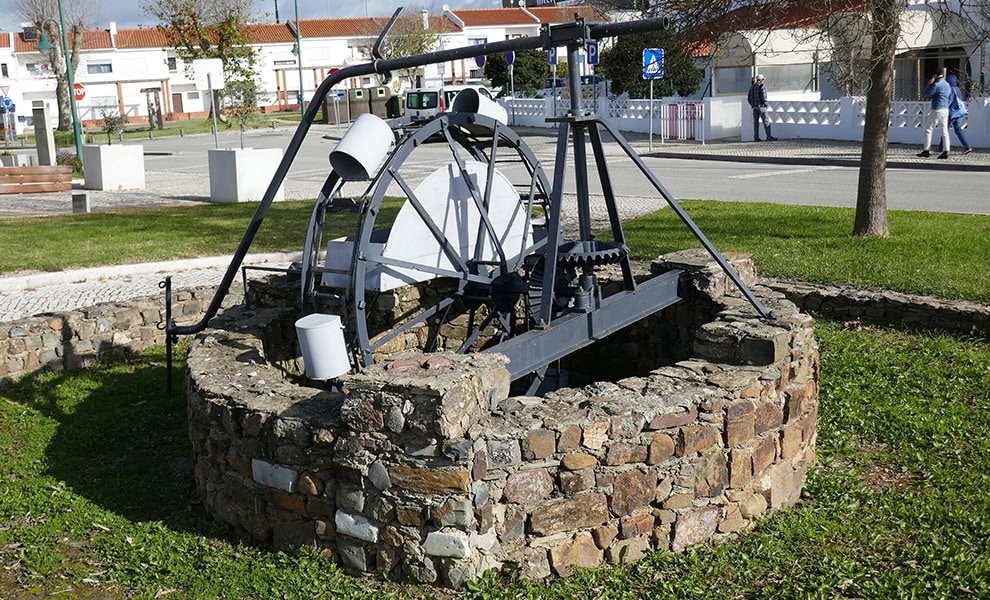
6. Bucket elevator: a looped chain of buckets
- For lifting water to tanks, reservoirs, or terraces above fields – typically wood, clay, or metal buckets and rope or leather straps.
A bucket elevator is the same underlying idea as the saqiya – buckets on a loop, dipping and lifting – but without relying on a wheel-and-gear mechanism. A simple rope or chain with buckets tied at intervals runs over a pulley or wheel, worked by hand or by an animal, dipping into the water at the bottom and carrying each bucket up and over the top before it empties and starts its journey down again. It’s a simpler, more improvised version of the same lifting principle – easier and cheaper to build wherever a full saqiya wasn’t practical or necessary. From Ancient Mesopotamia and India.
7. Pulley system: redirecting force to make lifting easier
- For feeding hillside terraces or upper-level fields – typically wood, rope, or leather.
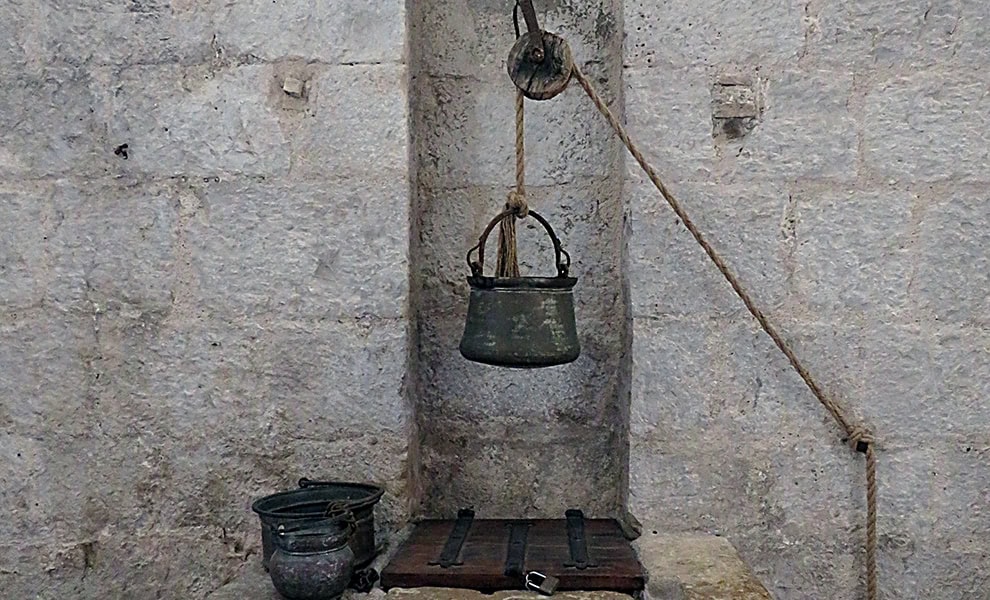
The simplest device on this list, a pulley, doesn’t make lifting water any less effortful (it can’t reduce the weight you’re lifting), but it does let you control the direction you’re pulling in. A rope runs over a wheel fixed above a well or terrace, with a bucket on the end; instead of hauling straight up, which can be awkward or even impossible on a steep terrace edge or a narrow shaft, you can pull downwards or sideways instead, using your own body weight to help. Pulleys are less about mechanical advantage and more about making an awkward physical position workable. From India, Egypt, and the Middle East.
8. Water-lifting windmill: early wind pump
- For lifting water from wells or rivers to higher terraces or storage tanks – typically wood and reeds for blades and wooden pump mechanisms.
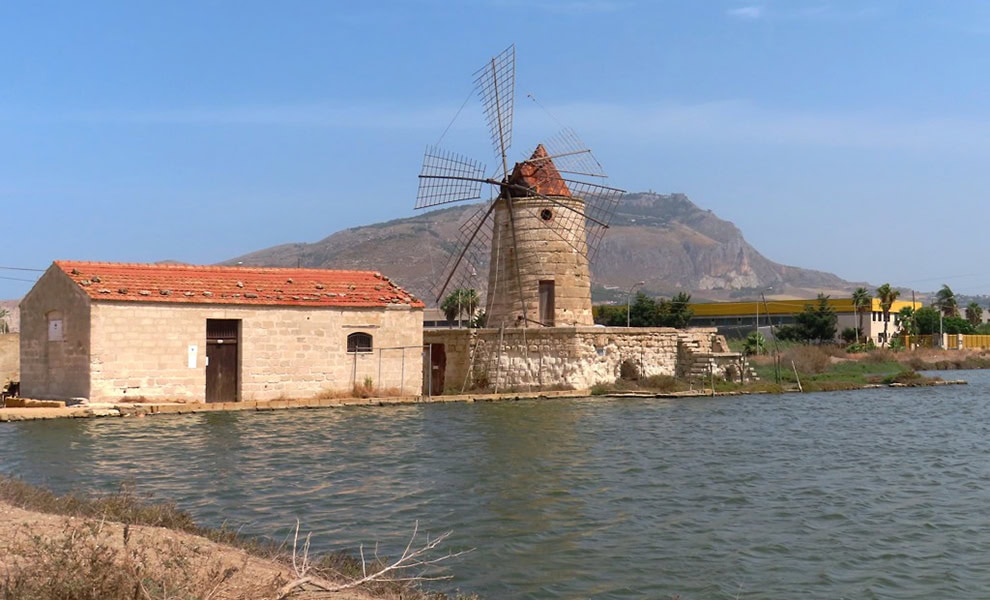
A mill swaps human or animal effort for wind. Sails or blades mounted on an axis catch the wind and turn, and that rotation is carried down through gearing to the lifting mechanism that sits below – often a scoop wheel similar in principle to a noria. As long as the wind blows, the pump keeps running with nobody needing to be there operating it. Entirely at the mercy of the weather, it was most suited to uses where a constant supply wasn’t essential. From Persia (9th–10th century CE).
9. Screw-lift fountain: for ornamental water features
- For supplying ornamental fountains uphill – typically lead or bronze pipes with wood or stone basins
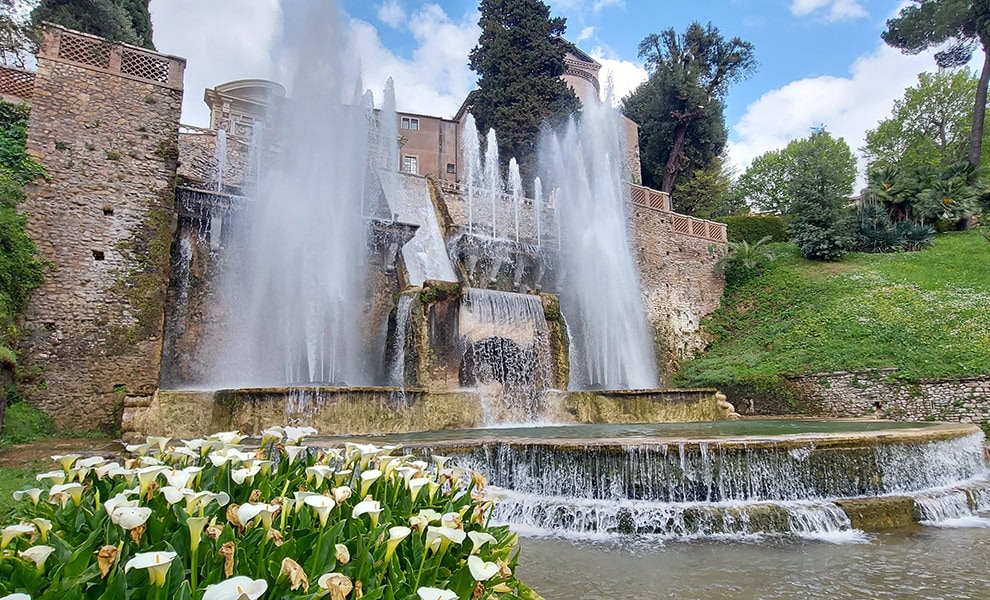
Less its own separate invention and more an application of the mechanisms already described, screw-lift fountains are scaled-down combinations of piston pumps, Archimedes’ screws, or siphons to lift water for ornamental purposes. Wealthy Roman villa owners had these built into their water systems specifically to lift water from lower cisterns up to fountains positioned somewhere higher – like a terrace, a garden feature, or an upper courtyard. The physics is identical to the full-size versions, but the end result was a jet of water rather than an irrigation channel, with water routed through decorative lead or bronze pipework. From Ancient Rome (used in villas and gardens), then Renaissance reconstructions (like the famous Villa d’Este, Tivoli, Italy).
10. Piston pump: sealed pressure/force pump
- For supplying water to fountains, baths, and city cisterns – typically bronze or wood cylinders and pistons with leather seals.
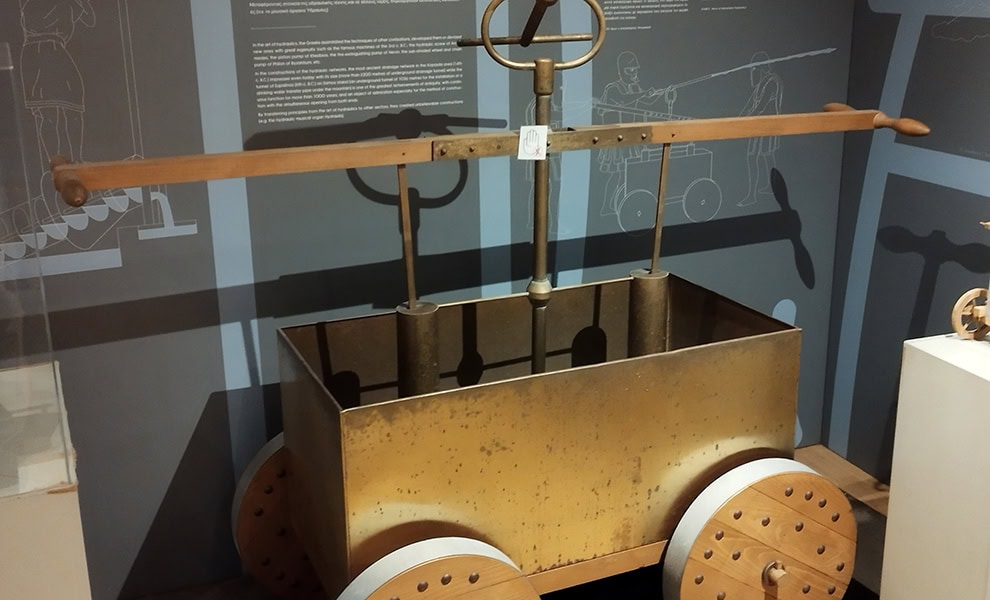
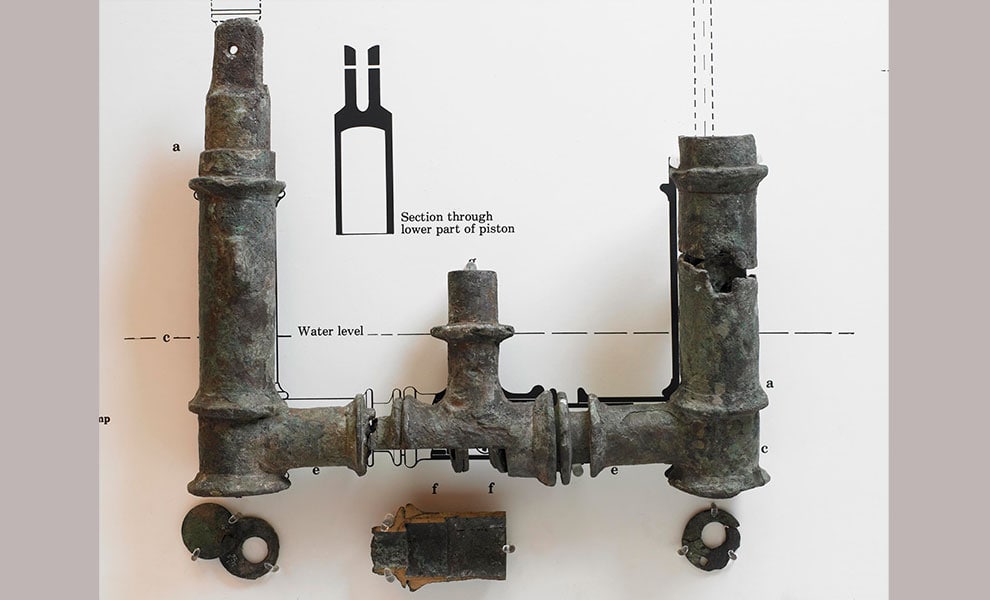
As the name suggests, piston pumps work on sealed pressure rather than open scooping or carrying. A piston fits tightly inside a cylinder, with valves positioned to control which way water can flow. Pull the piston back and a valve opens, letting water get drawn into the cylinder; push the piston forward and that valve shuts while a second one opens, forcing the trapped water out through a delivery pipe. Because the whole system is sealed, the pressure created by the piston’s movement can push water through pipework and even force it upward against gravity – something open bucket-and-wheel devices cannot do, as they rely on physically carrying water rather than pressurising it. Credited to Ctesibius of Alexandria, working in the 3rd century BCE, then spreading to the Roman Empire.
11. Hydraulic ram pump: lifts water without power
- For pumping stream or river water to a higher point – typically cast iron or steel ram body with valves (waste and delivery) and a delivery pipe. Modern DIY versions can be made with PVC pipe.
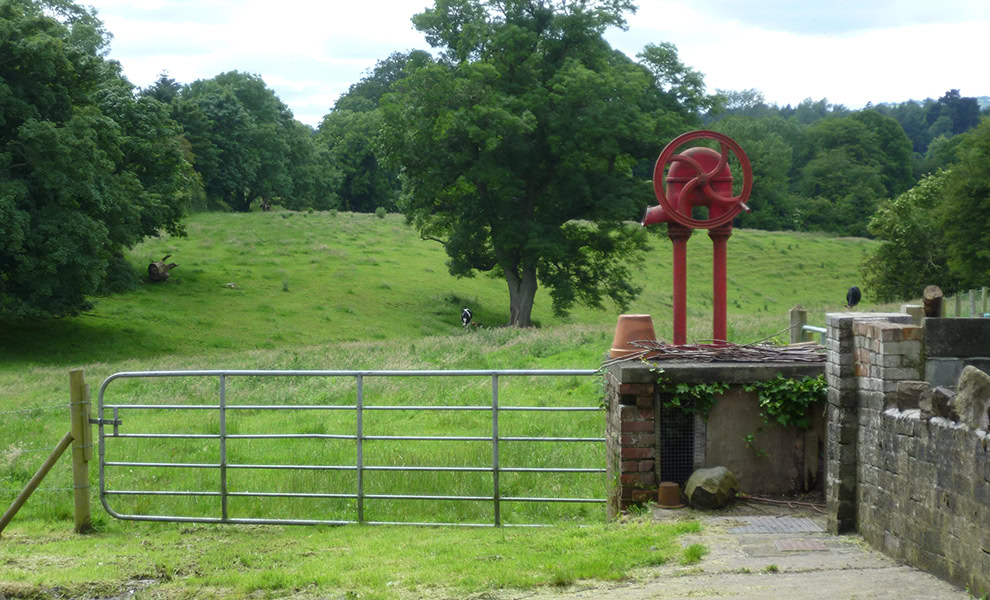
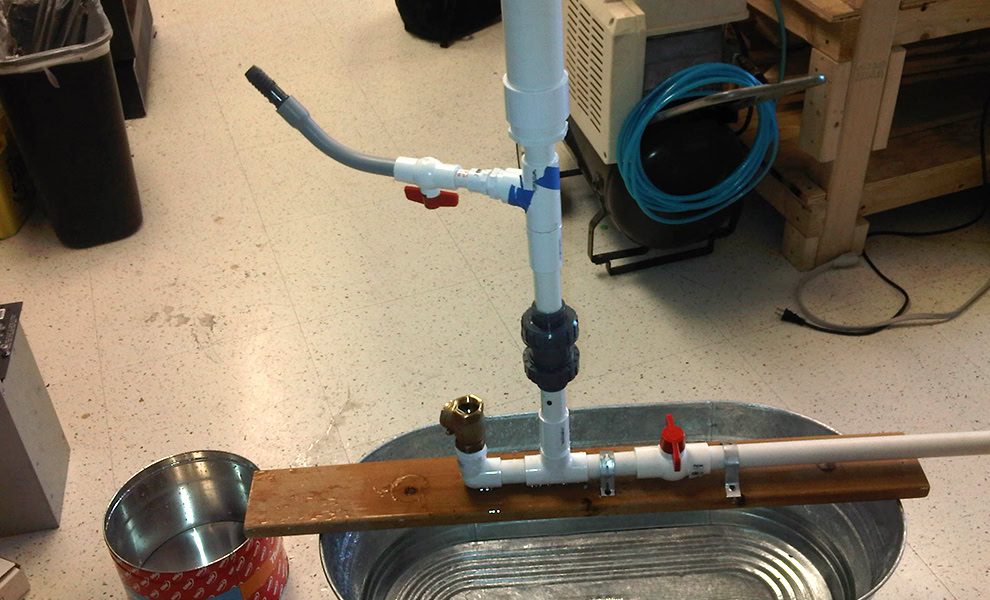
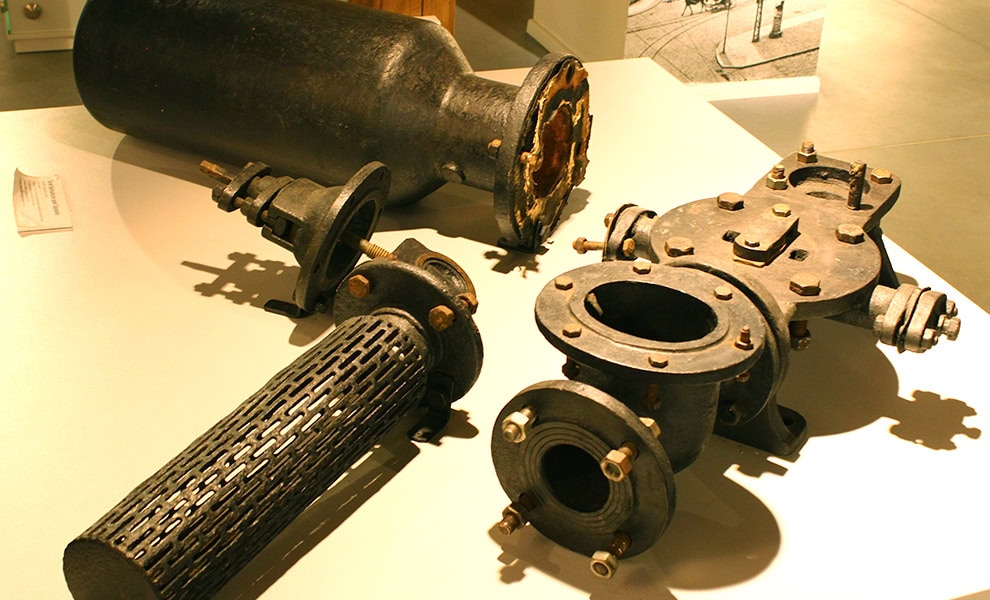
A ram pump is very interesting because it doesn’t need human, animal, or wind input at all. All that’s required is a stream with a bit of a drop in it. As water flows down into the pump, it hits a valve and slams it shut. The abrupt stop sends a sharp spike of pressure through the water (the same effect that causes pipes to bang when you turn a tap off quickly), and that pressure spike is forceful enough to push open a second valve and shoot a portion of the water up a separate pipe to a height well above where it started (sometimes many times higher than the original drop). Once the pressure spike passes, the first valve springs back open, and the whole cycle repeats itself automatically, over and over, powered entirely by the stream’s own flow. Ram pumps are a relatively new invention and widely used (especially in off‑grid farms, remote communities, and eco‑projects where mains power isn’t available). They are a great DIY project requiring no specialist knowledge, with many tutorials available online. Credited to Joseph Michel Montgolfier in 1796, then popularised in the 1800s.
Notes about low-tech water lifting methods
These methods for moving water upwards are excellent examples of low-tech solutions. The term ‘low-tech’ describes technology built from simple, readily available materials and understandable mechanical principles – favouring solutions that people can build, understand, repair, and share the knowledge of. It’s an idea that grew out of doubts about progress, growth, and technology in the early 1970s, when it became clear that more advanced wasn’t automatically better.
A philosophy has grown up around low tech, arguing that technological progress should be judged by whether it’s genuinely appropriate to a given need and place, rather than by how powerful or sophisticated it is. Drawing on E. F. Schumacher’s concept of “intermediate technology” and later writers like Philippe Bihouix and Kris De Decker, it calls for solutions scaled to what a community can actually build, maintain, and afford, favouring durability, repairability, and lower environmental cost over mere performance. Central to this is the value of “sobriety” – deliberately choosing simpler, lower-impact solutions where they’re genuinely sufficient for the task at hand.
Low tech is the opposite of modern, ‘high-tech’ consumer goods, which typically contain complex electronics, computerised control, or components whose function isn’t visible or intuitive from simply looking at the device. Repairability is a real issue with such technologies, as, even where manufacturers allow it, the components themselves are often too densely packed, miniaturised, or specialised to work on without professional tools and skills – a limitation no amount of documentation or spare parts can fully solve.
Solutions like a shadoof or saqiya are made from accessible materials, with skills that could be learnt or sourced locally. Even Ctesibius’s bronze force pump, arguably the most sophisticated device on this list, was assembled from separate pieces that could be soldered, cast, or reshaped by hand. A device built from such materials and simple mechanical principles stays useful for as long as its parts can be replaced, which is why several of these devices (the ram pump especially) are still being built and repaired today, sometimes over a century after installation.