Long before pumps and pipelines became motorised or electrified, civilisations across the world moved, stored, and cleaned water at a scale that still impresses engineers today. They did so using gravity, elevation, seasonality, and an intimate understanding of their environment built up over generations of observation.
This collective knowledge, and the practical solutions that grow out of it, is known as Traditional Ecological Knowledge (TEK). TEK is built up and refined over generations through trial and error, then passed on orally or through practice – embedded in customs, farming calendars, and community management rules.
There are lots of TEK examples of water management. What’s striking about the concepts below isn’t just their ingenuity but also their durability. Some methods are still in use around the world, and even those that were abandoned when ‘better’ modern alternatives came along are now being restored and rebuilt as sustainable and resilient approaches.
Six different systems/technologies are explored below, with some images by way of illustration in the Photos section at the bottom of the page.
1. Aqueducts: transporting water over long distances
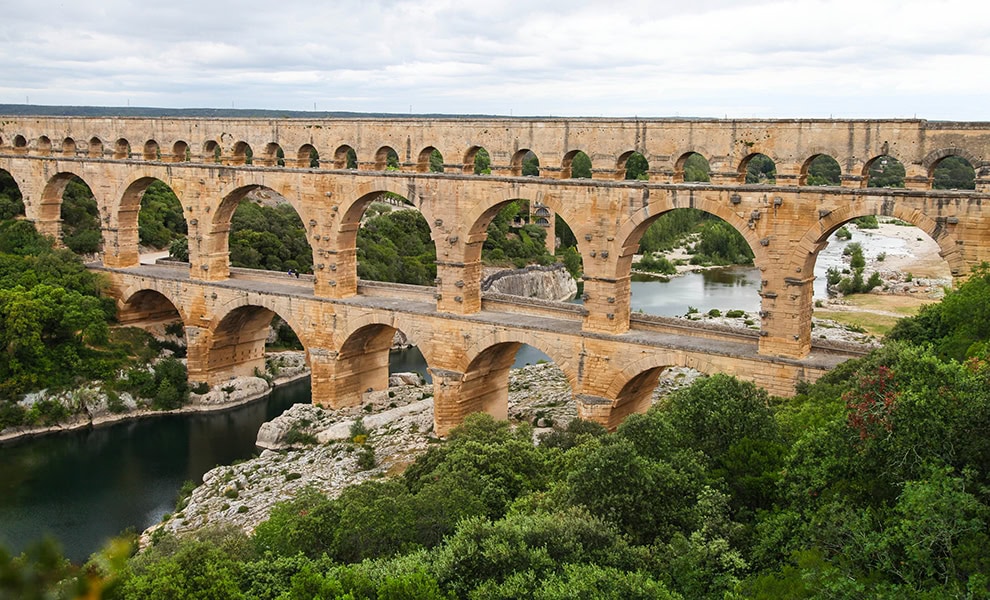
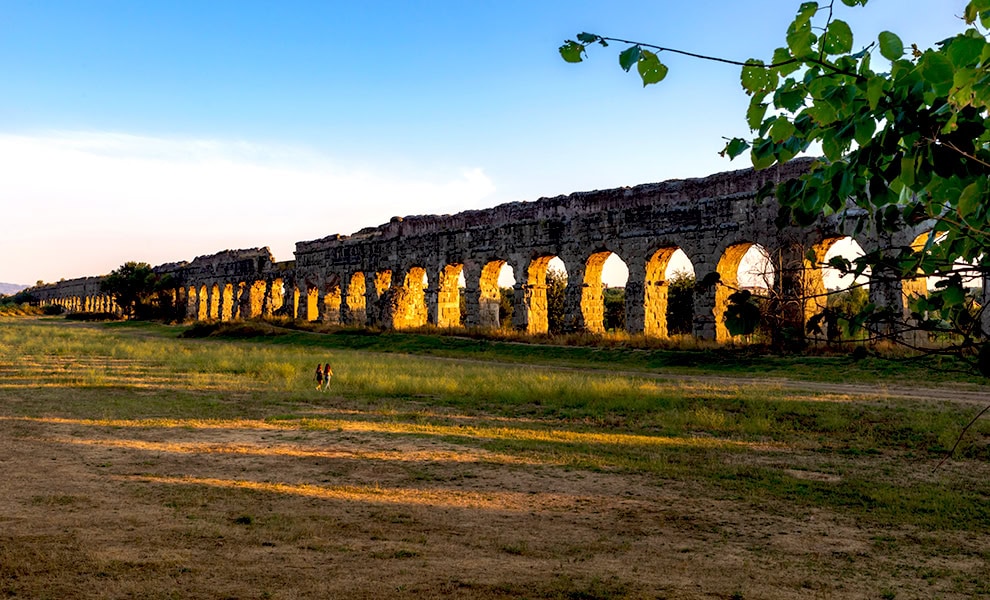
Although often associated with ancient Rome, aqueducts were also used by ancient societies in Greece, the Near East, Mexico, and Peru. Today, you can still see them striding across the landscape in countries like Italy, France, and Tunisia. Aqueducts are long channels or bridges built to carry water from rivers or springs to towns or farms. They work because water always finds its own level – a channel built with a very slight continuous downward gradient will carry water for tens of kilometres without any pump. Roman aqueducts typically dropped only a few centimetres per kilometre, just enough to keep the water moving gently (but not so much that it eroded the channel). Where the land dropped below the correct gradient, the channel became supported by a raised bridge (the arched structure most people picture) to keep the slope constant.
Hydraulic inverted siphon
Within the aqueduct system is a secondary engineering technique that was sometimes required: the inverted siphon. Where an aqueduct’s route crossed a valley too wide or deep to bridge, Roman engineers used pressure to keep the water moving. The channel dropped down one side of the valley into a sealed pipe, ran along the valley floor, then rose back up the other side to rejoin the gravity-fed channel beyond – the water being pushed uphill on the far side by the pressure built up from its own fall on the near side. It let the Romans maintain a continuous water supply across terrain that would otherwise have required impossibly long detours or bridges.
- Origin/use: Ancient Rome, though simpler forms existed earlier in older cultures. Used across the Roman Empire from Britain to North Africa and the Middle East.
- Effectiveness: Highly reliable, delivering large volumes of clean water consistently.
- Materials: Stone, brick, or concrete channels, on arches where the land falls away.
2. Cisterns: underground reservoirs for water storage at scale
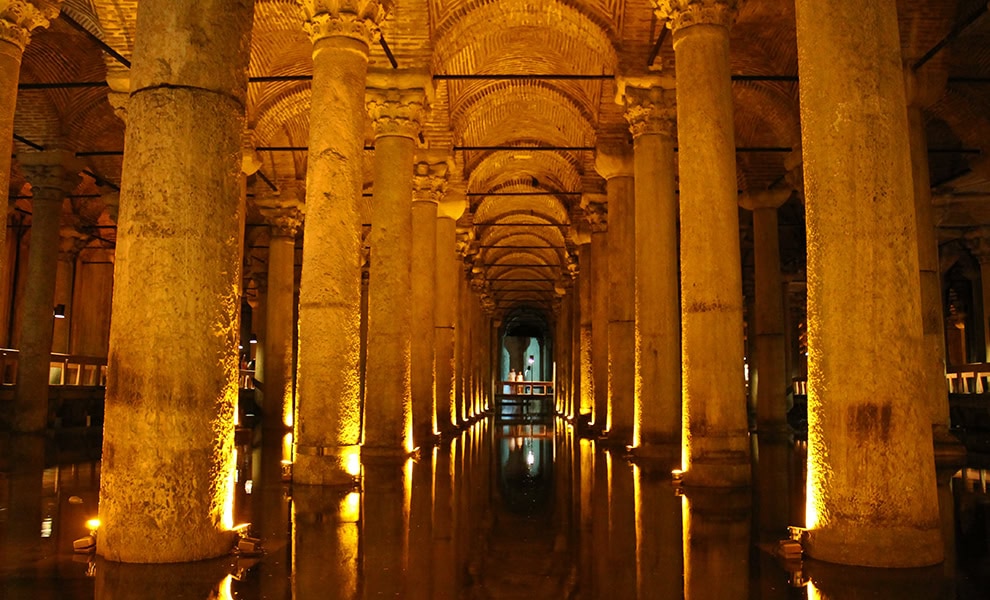
Cisterns work on the simple principle of storage against scarcity, capturing water when it’s available (like rain or seasonal river flow) and holding it somewhere it won’t evaporate or be contaminated. These are large tanks, often dug into the ground or built under buildings, lined with stone or brick if necessary and then waterproofed with a lime-based hydraulic plaster so the water doesn’t just drain away. Roman and Byzantine cisterns (like Istanbul’s Basilica Cistern) used rows of columns to support a brick or stone vaulted ceiling over a large underground chamber. Underground or sealed chambers keep the water cool and out of direct sun, which drastically cuts evaporation loss and slows algae growth compared with an open pond.
- Origin/use: Ancient Near East and Mediterranean (Bronze Age and earlier). Used from Egypt and Mesopotamia to Greece, Rome, and Arabia.
- Effectiveness: Excellent for dry seasons and drought resilience.
- Materials: Dug chambers lined with stone and/or plaster, often fed by rooftops or catchment basins.
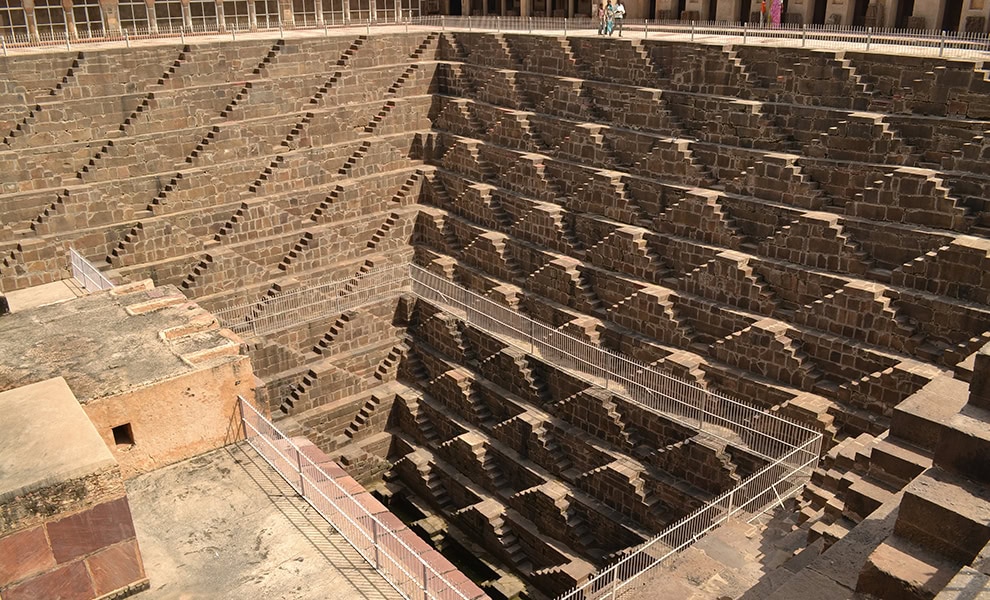
3. Stepwells: easy access to a shifting water table
Because groundwater sits below the surface and its level changes with the seasons, a stepwell provides a descending staircase down to whatever depth the water table happens to be at that time of year. Imagine it as an inverted step pyramid; where a classic well is a deep shaft that requires a rope and bucket or pump to bring the water up, people can just walk down a stepwell until they reach the water level – lower in the dry season and higher in the rainy season.
- Origin/use: Indian subcontinent from at least the early 1st millennium CE. Used in Rajasthan, Gujarat, and other arid zones of India.
- Effectiveness: Reliable access to groundwater through dry seasons.
- Materials: Excavated in rock/earth, often with ornate stonework.
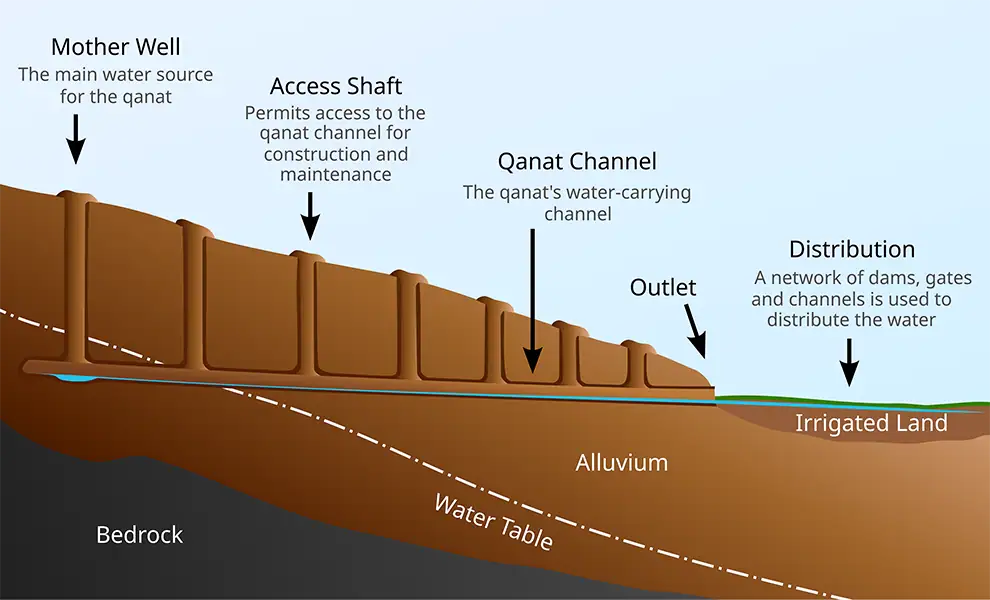
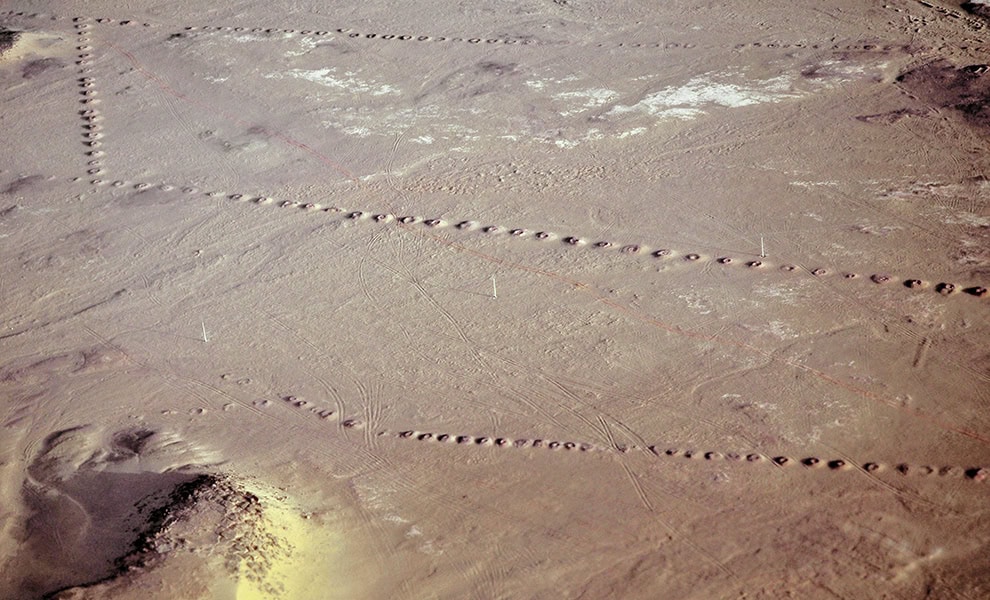
4. Qanats: underground channels to access aquifer water
A qanat taps into an aquifer at the base of a mountain or highland, where the water table is naturally close to the surface, and lets gravity carry it downhill through a gently sloping underground tunnel to farmland or a settlement at a lower elevation. It’s essentially an underground aqueduct, characterised by regular shafts made during construction which also facilitate maintenance. Being underground keeps the water from evaporating in the same way a cistern does, which matters enormously in hot, arid climates where an open canal would lose much of its flow before arrival. Puquios, which developed in South America (notably Chile and Peru), are very similar to qanats.
- Origin/use: Persia (Iran) around 1st millennium BCE. Use across the Middle East, North Africa, Spain, India and China.
- Effectiveness: Excellent in arid regions with low evaporation and continuous flow.
- Materials: A series of vertical shafts and a tunnel are dug by hand with simple tools.
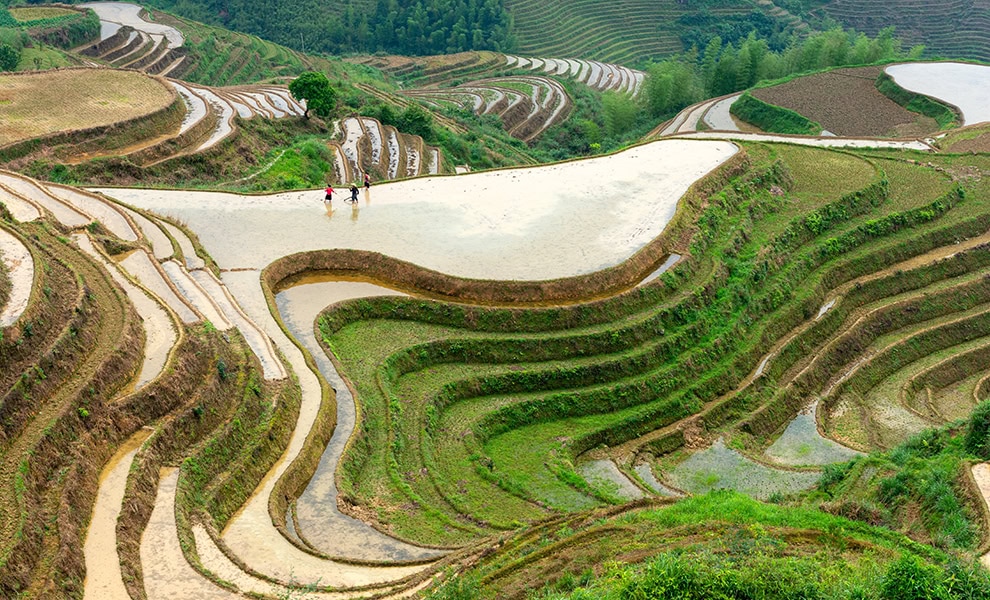
5. Terracing: irrigated steps to manage water on a slope
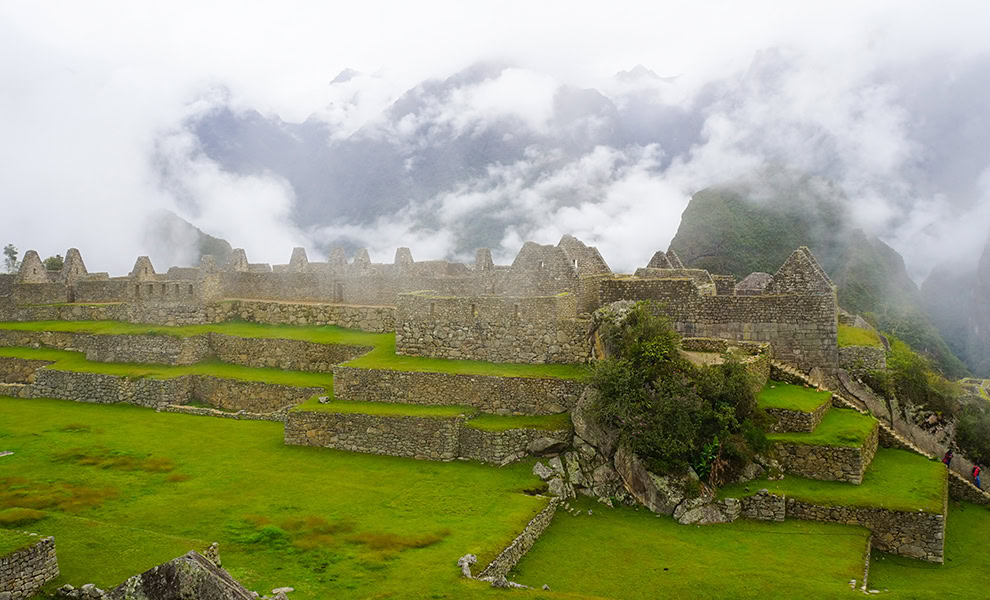
Terracing is a widespread practice in land management and agriculture that dates back to the Bronze Age. It solves the problem caused by rainwater running down slopes (rather than soaking into the ground where crops can access it) and taking topsoil and nutrients with it. Cutting a hillside into a series of flat, level platforms stops that runoff and erosion, meaning the slower water has time to soak in before it moves on. There is also a wet/irrigated form, where the terraces are actively irrigated via canals, aqueducts, or reservoirs that allow water to cascade down in a controlled manner. Classic examples are rice paddy terraces in Asia or Andean terraces (andenes) in South America.
- Origin/use: Pre‑Incan Andes and elsewhere for millennia. Used in the Andes, Asia (China, Philippines), and Mediterranean hills.
- Effectiveness: Reduces erosion and holds water very effectively.
- Materials: Earth or stone walls with channels to distribute water between levels.
6. Waru waru: raised beds with microclimate water channels
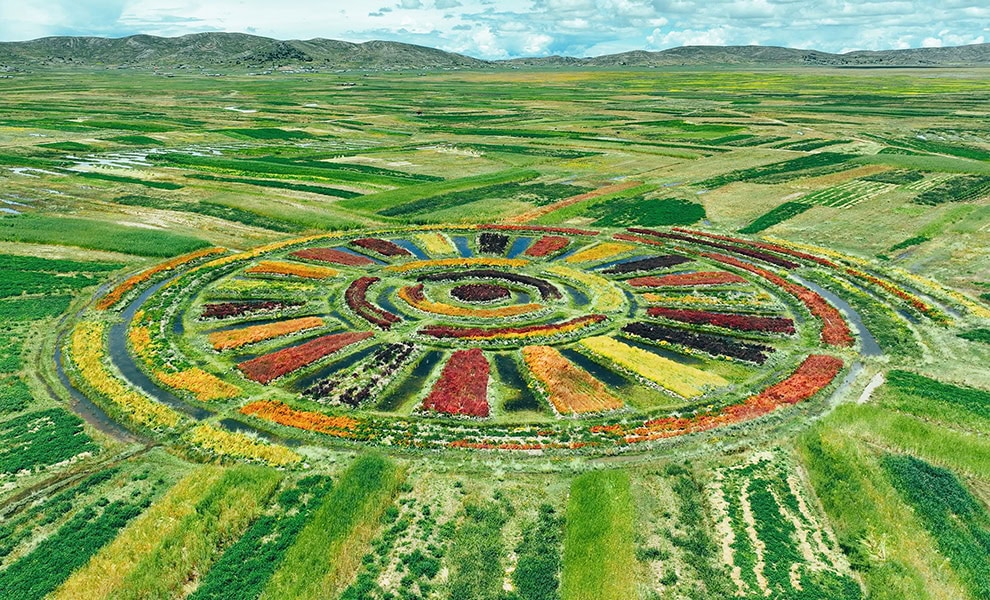
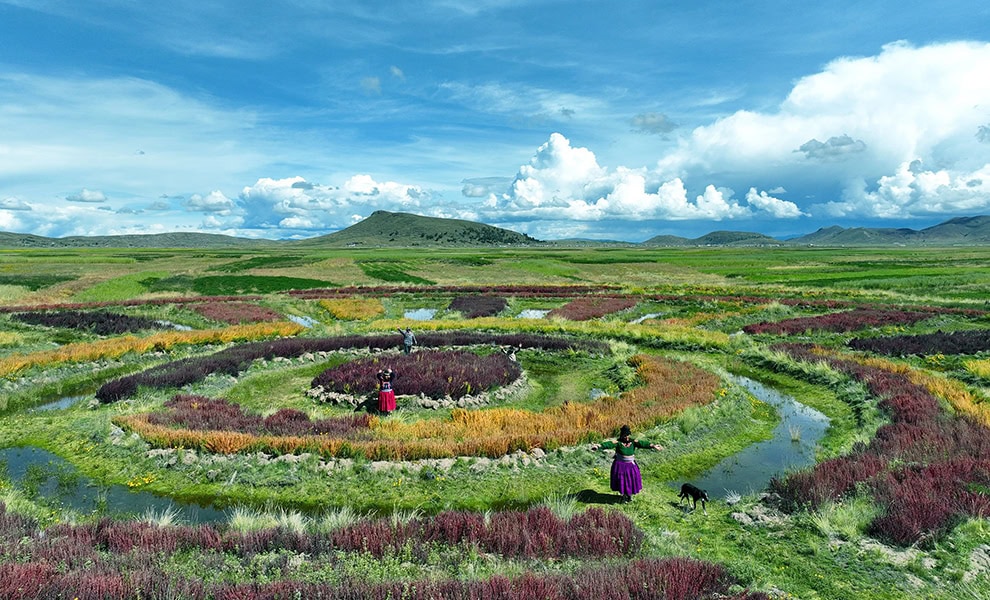
An agricultural system developed in the Andean region (particularly Peru and Bolivia), waru waru consist of a series of raised planting fields separated by water-filled channels. Their location on floodplains and near rivers means the channels can readily be refilled, with the raised beds keeping roots above waterlogged ground during flooding and the channels retaining moisture for the plants to draw on during dry spells. Soil fertility is enhanced thanks to the nutrients supplied by aquatic plants and other organic materials. Another benefit of this system is frost protection. By day, the water in the channels absorbs heat; by night, it releases that heat slowly, warming the air around the crops and reducing frost damage at high altitude. In some regions of Peru, these raised fields are called suqakollos.
- Origin/use: Andean highlands from about 3000 – 1000 BCE. Used around Lake Titicaca (Peru/Bolivia) and in pre‑Inca cultures, it is being revived by indigenous farmers there today.
- Effectiveness: Higher yields, frost protection, and drought resilience.
- Materials: Trenches are dug by hand, with soil transferred to the raised beds; water is brought in via canals.
Notes about indigenous water management
Ancient water systems endured because they were built as relationships, not solutions. A qanat doesn’t extract an aquifer but follows the aquifer, matching its path to wherever the water naturally sits. A stepwell doesn’t assume a fixed water table but moves with it. Terracing doesn’t stop a slope’s propensity to shed water but works with that tendency, slowing it in stages. These systems hold up under climate pressure in a way rigid modern infrastructure doesn’t. Adaptability isn’t an added feature; it’s the design principle itself – built to keep functioning as conditions shift rather than engineered for one assumed, unchanging condition.
These TEK principles hold at any scale because they’re not really about the size of the structure. For example, a swale (a shallow, gently sloped channel with a raised bank on the downhill side) does at a garden scale exactly what a terrace does on a hillside: slowing water and giving it time to soak in rather than run off and take topsoil with it. A cistern’s defining feature (not just storing water but keeping it away from sunlight) has an equally direct small-scale equivalent: a water butt or storage tank sited in the shade or buried keeps stored water cool and dark, slowing evaporation and stopping algae growth.
The systems described here may be larger scale than our home or farm or community venture requires, but we can still take inspiration from them. You don’t need to be an engineer to start using water more intelligently, just someone who harnesses the behaviour of water. Start by asking the same question our ancestors asked themselves: where does water naturally want to go, and how do I work with that, rather than override it?
We can choose to rely on garden taps and electric pumps, or we can opt to embrace the ‘constraint’ of not needing either and experiment with our own versions and variations of these technologies.
Frequently asked questions (FAQ)
What is Traditional Ecological Knowledge (TEK) and why is it important?
Traditional Ecological Knowledge (TEK) works with the landscape in a way that modern infrastructure often doesn’t. These technologies start from the same premise: read what the local environment is already doing (where water naturally pools, where a slope naturally drains, or where an aquifer naturally sits close to the surface) and build a structure that harnesses that behaviour rather than overriding it. For example, a qanat follows the water table downhill, and terracing works with a slope instead of flattening it. They don’t fight gravity, geology, or seasonal cycles but move with those forces. That’s why they don’t need external energy input: the landscape itself does the work.
Modern water infrastructure inverts that logic almost entirely – pumping water uphill, damming rivers, depleting groundwater, adding chemicals, channelling waterways, draining wetlands, and desalinating seawater regardless of the long-term impact and often requiring centralised, power-hungry systems. The problem with so many of our more recent solutions and habits is that we see nature as an obstacle to be overcome – any constraints can simply be overpowered if we use enough energy and engineering. With water, for example, we’ve reversed in decades what took millennia to create. The only sustainable way forward from here is to adopt more local, adaptive, and cooperative practices.
Why is rainwater harvesting not included in the list?
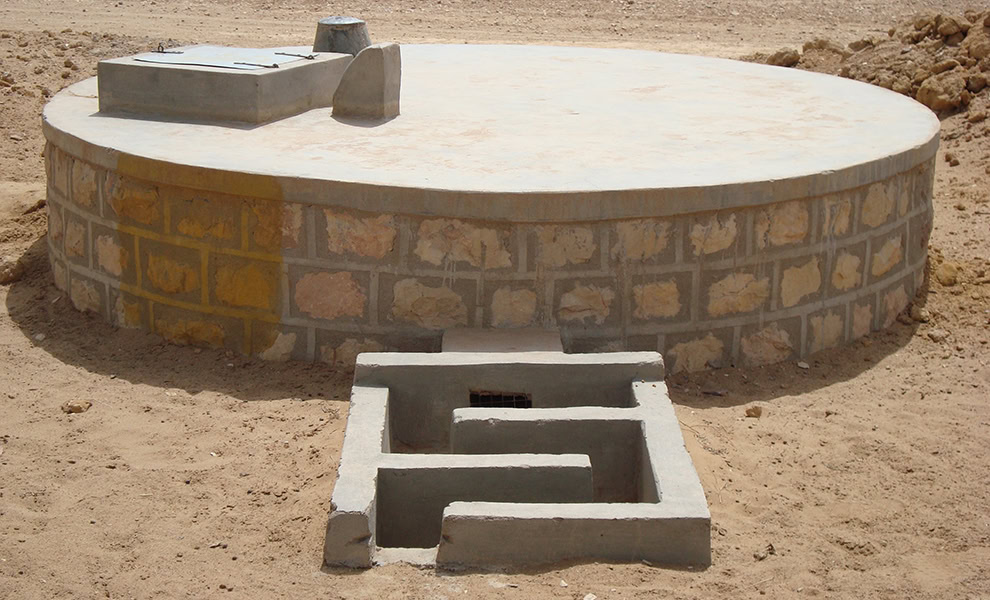
Rainwater harvesting (channelling runoff into a storage tank to capture water that would otherwise simply be lost) isn’t on the list because it isn’t really a single technology in its own right but a principle that gets implemented differently depending on what a community already had available. It’s simply the first step of the management systems we’re discussing here (catch runoff before it’s lost and then store it or move it for later). If we take a rooftop channelled into a taanka, a courtyard sloped toward a cistern, or a carved rock catchment feeding a stepwell – these aren’t separate inventions so much as the same basic idea applied to whatever structure was already in use for storage.
It’s impossible to find a single traceable origin for rainwater harvesting the way we can for qanats or waru waru. Catching rain in an available container is an obvious response to needing water and would have been arrived at independently by every settled human population with a roof or hard surface. Directing and collecting water is a universal behaviour that predates engineered structures.