There are lots of reasons to use mulch in your garden or outdoor space. Some are aesthetic, some are practical, but typically they are both. In this how to, we’ll look at the different materials you can use and their benefits/drawbacks. Applying mulch can be a great way to use up materials that would otherwise be considered waste, closing the nutrient loop by returning materials to the soil where they originated, rather than exporting them as waste. Even if the materials haven’t come from your own plot, you may be able to recycle locally sourced ‘waste’ for your mulch and save it from landfill.
How to landscape and protect soils with mulching
You can mulch with pretty much anything, depending on your budget. Use different mulches to distinguish the different areas of your garden or for different cultivation needs. Think about what you can source easily, cheaply, locally, and repeatedly.
1
- Mark out the areas you want to mulch (for curvy lines, use a hose or rope or pour a line of sand or lime and for straight lines, string and spikes work well).
- Use an edge cutter or spade to dig a clean line between areas (between a grass path and a bed, for example).
- If needed, you can add edging materials like bricks, logs, etc. You can do this at the end if you prefer.
2
- If you are mulching for soil and plant health (as opposed to a path), thoroughly wet the area to be mulched.
- If placing sheeting (paper, card, natural fibres) under your mulch, lay this out too, making sure it overlaps (see notes below). Pin or weight overlaps until the mulch layer above secures everything.
- Wet the sheet mulch thoroughly before applying your main mulch.
3
- Bring your mulch material onto the mulch area (shovel it, carry it, etc.) and start to spread it around, keeping it away from the stems or trunks of plants and trees.
- You want a thickness of 3 cm to 20 cm depending on what you are using and how often you plan to replenish it.
4
- Water the mulch to help it settle and wash it off leaves and un-mulched areas.
- If necessary, rake the area flat (particularly for gravel or wood chip mulches).
5
- As each new season arrives, check the depth and coverage of your mulch. Add more in areas where it has rotted down or been displaced.
- Check for weeds and tidy as necessary.
- Organic mulch will probably need to be replaced every couple of years.
Variations & alternatives
You have lots of choices when it comes to mulch - wood chips, bark, leaves, grass clippings, straw, hay, compost, pine needles, newspaper, cardboard, cocoa shells, seaweed, shredded prunings, sawdust, wood shavings, peat, gravel, stone, pebbles, slate, rubber chips, landscape fabric, plastic sheeting, living mulch (ground covers), mushroom compost, aged manure, coffee grounds, wool, hops waste, nut shells, rice hulls. Let's explore some of your top options.
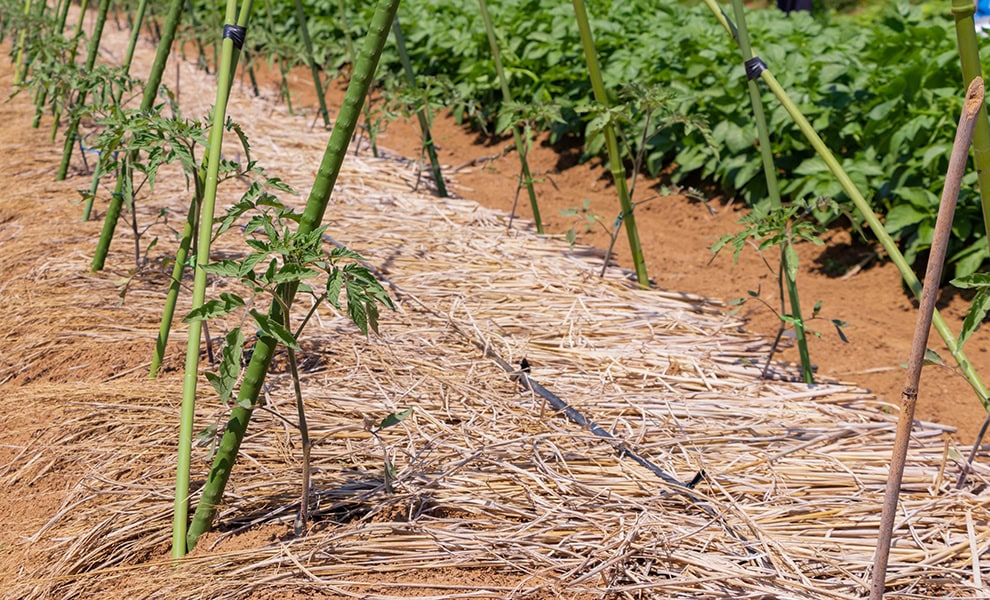
Mulching with straw and hay (biodegradable)
Straw and hay make great, cheap mulches. Straw is the hollow stem left after grain harvest (wheat, oats, and barley), a bi-product often used as animal bedding. Hay is dried grass, legumes (like clover or alfalfa), and meadow plants cut while still green and leafy, then dried for use as animal fodder.
Straw is often considered ‘better’ than hay despite both being grass-related because it contains minimal seeds, while hay is loaded with viable seeds of all kinds of plants that will sprout in your beds. If you use hay, expect to deal with grass germination unless it’s been through an animal’s digestive system first (as in aged manure with hay bedding). You can apply at least 15 cm of depth since they compress and break down quickly – within a single growing season in warm, moist conditions.
Straw works well for pathways, around strawberries (hence the name), and as winter insulation for perennials, but it looks agricultural rather than ornamental and blows around until it settles or gets wet. It’s high-carbon (C:N around 80:1), so it won’t cause nitrogen issues when used as surface mulch. Practical for productive gardens where function trumps appearance and you have cheap access to bales, but not ideal for garden landscaping or anywhere you want permanence.
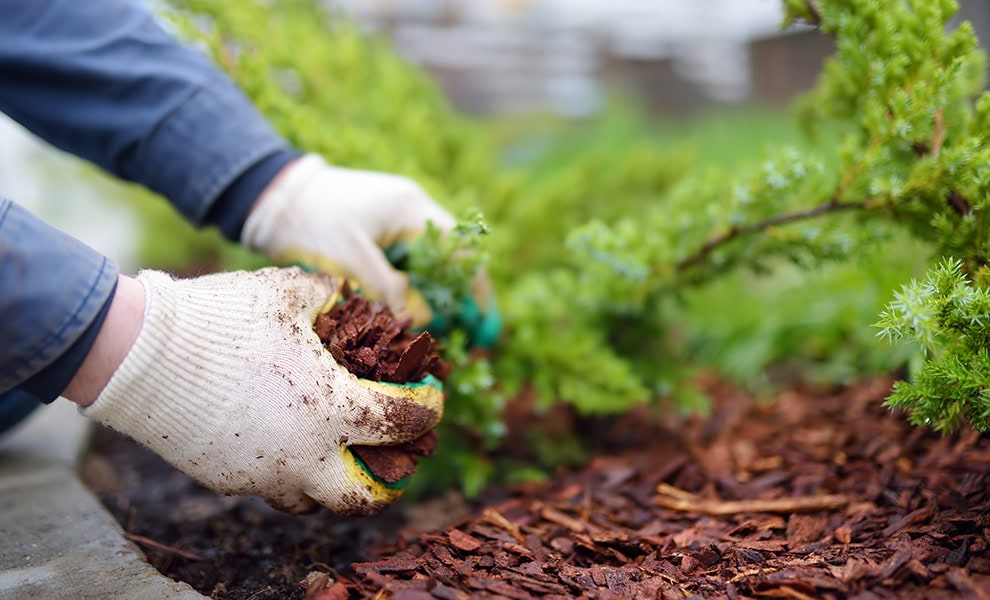
Mulching with wood chips, bark chips, and chipped prunings (biodegradable)
Wood chips, bark chips, and chipped prunings are cheap, long-lasting mulches that work especially well for established plantings. They are often free, last 2 – 4 years, and work fine fresh despite myths about needing to age them (surface application doesn’t cause nitrogen problems). Shredded bark costs more but looks very uniform and lasts slightly longer.
Ramial chipped wood (RCW), also known as BRF from the French name ‘bois raméal fragmenté’ or chipped branch-wood, is made from branches under 7 cm in diameter. You can chip this with leaves on, depending on the season. It breaks down faster and enriches soil better than aged wood.
All wood mulches suit trees, shrubs, and perennial beds but not vegetable gardens where you’re constantly working the soil. Keep them away from building foundations to avoid termite issues and moisture damage. Sawdust is too fine and compacts badly – compost it first or use only for paths. Main advantage: one arborist load mulches large areas for years at little cost.
Mulching with sawdust, wood shavings, and coconut coir or coco fibre (biodegradable)
These fine mulches require more care than coarser wood materials. The fine texture means they compact easily when wet, forming a dense layer that can actually repel water rather than letting it through; you can see water running off the surface instead of soaking in. This makes them problematic around plants that need consistent moisture. The high surface area relative to volume also means they tie up nitrogen more aggressively than wood chips when decomposing, though this still mainly matters if you mix it into soil rather than leaving it on top.
Fine mulch works better on pathways where compaction is less of an issue and you want a firm, relatively weed-free surface. It’s also useful mixed with higher-nitrogen materials in compost piles to balance carbon content. Some gardeners use aged or partially composted sawdust, wood shavings, etc., successfully around established shrubs and trees at a 3-5 cm depth, keeping the mulch from direct stem contact. Fresh sawdust from treated timber should be avoided entirely due to chemical contamination. The practical reality is that sawdust is often free from sawmills or woodworking shops, making it tempting despite its limitations – if you use it, apply it thinly, fluff it occasionally to prevent matting, and expect to supplement nitrogen for anything you’re actively growing.
Mulching with hemp shiv, hemp chaff, or hemp hurd (biodegradable)
Hemp shiv is made from the woody inner core of hemp stalks, broken into small pieces of up to around 20 mm. Sold as animal bedding or for traditional construction, it is relatively cheap, but its use as a mulch is problematic. It’s chunkier than sawdust but finer than wood chips, very lightweight, and doesn’t absorb water well. It doesn’t compact as badly as sawdust because the pieces are more rigid and create air pockets, but it’s light enough to blow around when dry and can still mat somewhat when wet.
Hemp shiv, like fine mulches, can form surface crusts that make the soil surface drier. The rigid woody pieces create air spaces that allow evaporation from the soil beneath. Water drains through quickly rather than being retained near plant roots at the surface level. If your plants need reliable moisture, hemp shiv isn’t the best choice – you’d need to water more frequently than with moisture-retentive mulches or use something else.
Because the pieces are small and lightweight, hemp also doesn’t work particularly well for mulching paths, as the little pieces are easily tracked onto other areas. It does, however, work well as a base layer on pathways – it’s permeable so water drains through rather than pooling, and it creates a stable underlayer that prevents mud. Top it with gravel, slate chips, or brick for a firm walking surface. The hemp provides drainage and weed suppression underneath while the top layer handles foot traffic.
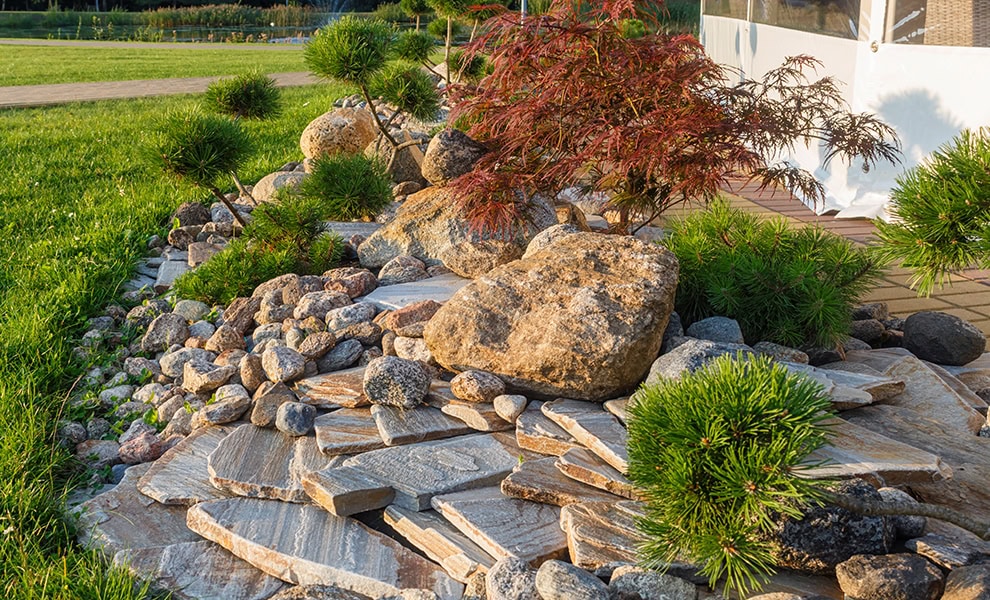
Mulching with stone, gravel, pebbles, slate, and bricks (inorganic)
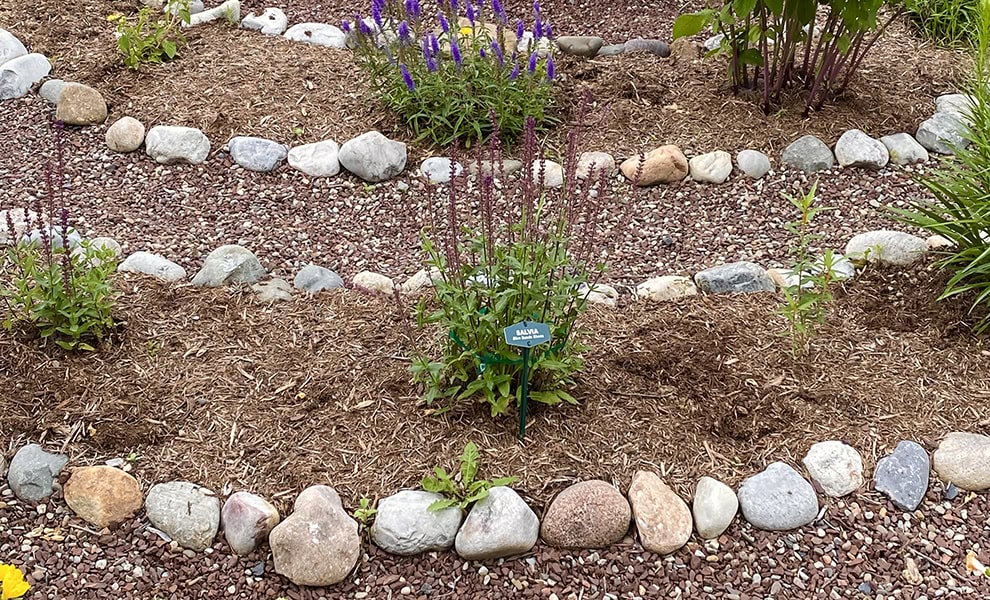
Materials such as stones, pebbles, and bricks form a permanent inorganic mulch that never breaks down. Effective for weed suppression, these materials work well in dry gardens or xeriscaping where their heat retention suits Mediterranean or desert plants. You won’t need to replace them often, if ever, meaning they are a good long-term investment.
These materials allow water through but don’t retain it, so soil beneath stays drier than with organic mulches. This makes them poor choices around moisture-loving plants but excellent for lavender, rosemary, sedums, or other drought-tolerant species.
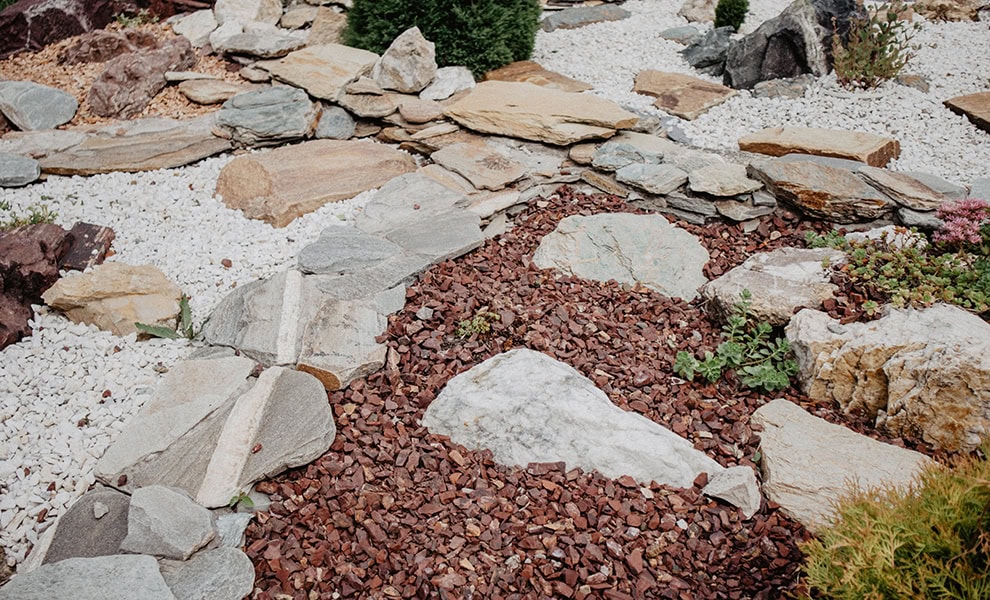
Gravel and pebbles come in various sizes and colours and settle into a stable surface. Slate chips are flatter and interlock well, needing less depth. Bricks – whole or broken – add warmth and texture but are heavier and can compact the soil underneath over time.
All stone mulches absorb and radiate heat, warming the soil in spring but potentially overheating it in summer, which limits their use around shallow-rooted or heat-sensitive plants. They’re maintenance-free but difficult to remove if you change your mind, and organic debris (leaves, seeds) collects on top, eventually creating a thin soil layer where weeds will germinate. Use landscape fabric underneath only if you’re certain you want to create a permanent barrier; it’s better to rely on adequate stone depth alone for weed control.
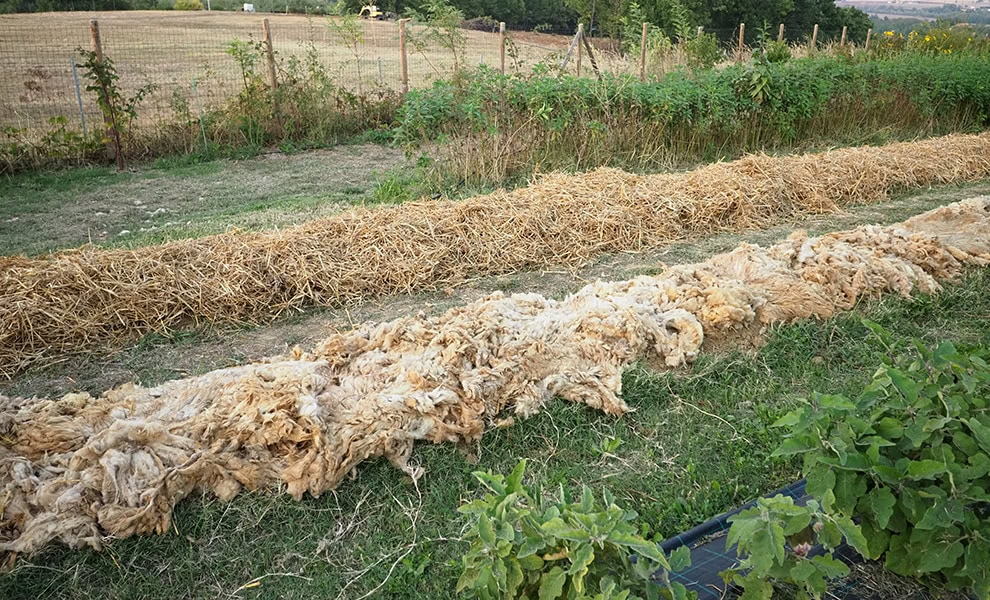
Mulching with sheep's wool (biodegradable)
Some people find that straw and hay mulches attract too many slugs and snails. If you have access to waste fleeces (in many parts of the world, farmers struggle to sell their wool and are keen to get rid of it for little or no money), wool is an excellent alternative mulch.
The texture of wool creates a natural barrier against slugs and snails, which seem to dislike moving across it. It also insulates well, buffering plant roots against both heat and cold better than many other organic mulches. When applied thickly enough, it suppresses weeds effectively while still being fully biodegradable. Wool also moderates soil moisture well, absorbing excess water during rain and releasing it slowly as soil dries.
As it decomposes, wool contributes nutrients to your soil too – nitrogen, phosphate, potassium, and sulphur. The decomposition is slow compared to green materials, so it acts as a slow-release fertiliser rather than a quick nutrient dump.
You can use raw fleece or buy compressed wool pellets, which are easier to handle and apply evenly but come with a higher cost.
Mulching with living mulches (permanent planting)
Living mulches are low-growing plants used as ground cover to suppress weeds, retain moisture, and protect soil while occupying the same space as taller crops or ornamentals. Common choices include clover, creeping thyme, vetch, or low sedums – species that spread horizontally, tolerate some shade or foot traffic, and don’t aggressively compete with main plantings. Or you can opt for bigger plants that do a really effective job of keeping competitors away – for example, comfrey, which has the added benefit of producing copious amounts of leaves for you to cut and drop wherever you need. The concept is that live plant cover does what mulch does (soil protection, weed suppression, moisture retention) while also photosynthesising, fixing nitrogen in some cases, supporting pollinators, and looking beautiful.
The key to using living mulches is managing resources. Living mulches need water and nutrients too, which can stress your primary plants (particularly in the establishment phase or with shallow-rooted crops). They will require some management such as mowing, trimming, or pulling back growth that encroaches too much. In orchards or around established trees and shrubs this balance is easier; in vegetable beds it’s trickier since you may disturb the soil more and many living mulches can’t handle that disruption. Some like white clover fix nitrogen and theoretically benefit companion plants, but the evidence is mixed on whether that nitrogen becomes available in useful amounts without incorporation.
Mulching with sheets of newspaper or cardboard (biodegradable)
Cardboard and paper act as a ‘sheet’ layer that has another biodegradable mulch placed on top (straw, for example), rather than as a true mulch. The job of this layer is to eliminate existing vegetation by excluding light and smothering. So sheet mulching is useful when converting lawn or weedy areas into beds without digging, creating a no-till transition that relies on exclusion rather than excavation. The appeal of this approach is it works with natural decomposition, avoiding soil disturbance and weed seed exposure while building upward.
If using paper or newspaper, you will need a thickness of at least 10 sheets. Cardboard should be two or three layers thick, but stick to card without glossy print and remove any tape. Sheet mulch works best if what’s underneath dies before the sheet breaks down. That means it’s fine for annual weeds and grass but less reliable against bindweed, horsetail, or established perennial roots that can wait out the barrier. You can opt to cover the area with black plastic first to weaken tougher plants first and then replace this with card/paper, but remember that without light or airflow, you’re creating an anaerobic environment hostile to the soil organisms that build fertility.
Some people find the moist cardboard layer can create favourable conditions for fungal growth, particularly in damp climates or poorly-drained sites. The decomposing cellulose and dark, humid environment between cardboard and soil encourages fungal colonisation, which some see as problematic if they’re worried about fungal diseases spreading to plants. However, fungal activity is actually part of how the system works – fungi are primary decomposers of cellulose and are breaking down the cardboard as intended. Most of these are saprophytic fungi feeding on dead material, not plant pathogens. The question is whether you view increased fungal presence as beneficial (building soil fungal networks, decomposing material) or risky (potential disease reservoir).
Mulching with geotextile, landscape fabric, or weed membrane (non-biodegradable)
Geotextile (landscape fabric, or weed membrane) is a woven or non-woven synthetic material designed to suppress weeds while allowing water and some air through. Like the card and paper sheet mulch, it’s meant to be covered with another mulching material (inorganic or biodegradable). It’s popular because it’s quick and easy to use and works effectively when new (blocking light to prevent germination while being permeable enough not to create fully anaerobic conditions like plastic does).
However, this type of material is problematic over time. Organic matter – leaves, dust, decomposing mulch – accumulates on top and creates a thin soil layer where weeds germinate anyway, rooting into the fabric itself. Removing these weeds damages the material. Meanwhile, plant roots from desirable species struggle to penetrate deeply, and soil life beneath is partially isolated from surface organic matter that would normally feed it. The fabric creates a barrier layer that prevents natural soil building. It also prevents you from adding compost or amendments to the soil without cutting through the fabric.
Geotextile degrades from UV exposure, physical wear, and root penetration, fragmenting and contaminating your soil indefinitely. This is particularly problematic in edible gardens where you’re concerned about plastic contamination in the food chain, but it’s an issue anywhere you care about soil health or environmental impact. The degradation timeline varies; cheaper non-woven fabrics break down faster, while heavier woven versions last longer but still eventually fail. Either way, you’re introducing a persistent synthetic material that doesn’t decompose, just disintegrates. Even ‘biodegradable’ landscape fabrics can contain plastics that break down into microplastics rather than truly disappearing. This long-term contamination aspect is why many gardeners who initially used geotextile now avoid it entirely, preferring thick organic mulch layers that actually decompose, even if those require more frequent renewal.
Mulching with natural fibre fabrics like hemp, jute, coir, or wool (bio-degradable)
There are more and more natural fibre landscape fabrics, the biodegradable alternative to synthetic geotextiles. Examples of the – often mixed – materials used in these products are hemp, jute, coir, flax, paper, maize, and wool. They function similarly to geotextiles but are designed to break down completely depending on material, thickness, and conditions, leaving no persistent residue. Care should be taken when sourcing such fabrics, though, as brand names containing words like ‘natural’ don’t mean the product doesn’t contain a significant amount of plastic. Some products blend natural fibres with synthetic binding, so check specifications if you want fully plastic-free. These products are quite expensive, which may make them unsuitable for mulching large areas.
Mulching with rubber chips or vulcanised rubber (inorganic)
Rubber mulch – shredded or chipped from recycled tyres – is marketed as long-lasting and low-maintenance and won’t decompose or blow away. It doesn’t compact, drains well, and lasts years without needing replacement. It’s used around playgrounds for impact cushioning and in landscaping where permanence is valued over soil building.
BUT, the problems are significant. Tyres leach chemicals, including heavy metals (zinc, lead, and cadmium) and volatile organic compounds, into soil and groundwater. The material doesn’t biodegrade but does break down physically into progressively smaller rubber particles that contaminate soil. It’s flammable and difficult to extinguish once ignited. The material heats up substantially in sun, making it unsuitable around plants sensitive to root zone temperature. It prevents any organic matter from reaching or building soil beneath.
The ‘recycled’ marketing spin on this product obscures that you’re essentially spreading industrial waste on your land. Any of the inorganic or biodegradable options listed above are better choices for longevity without contamination.
Notes about using mulch
The cost of mulch is marked as variable because plenty of mulches can be obtained for free or very cheaply (you can chip your own organic waste, or you can purchase straw at minimal cost or get it for free if it’s spoilt). But you can also pay significant amounts for decorative stone, antique bricks, etc.
Sheet mulching materials need adequate overlap to prevent weed breakthrough at the seams, so overlap more if dealing with aggressive weeds like bindweed or couch grass. The amount of overlap depends on the material you are using. Newspaper and cardboard should overlap 15cm to 30cm; geotextiles and natural fibre rolls can overlap 10 to 15cm. The overlap zone is the failure point in any sheet mulching system – skimping here means weeds exploit gaps, undermining the entire layer.
Compost as mulch works at 3cm to 5cm since it’s dense and nutrient-rich. Fine materials like grass clippings or shredded leaves should stay under 5cm. Organic mulches need 5cm to 10cm depth. Wood chips, bark, and shredded hardwood work well at 7cm to 10cm. Straw and hay are lighter and compress, so apply 15cm to 20cm initially, expecting it to settle to half that.
Frequently asked questions (FAQ)
Does mulch kill weeds?
A major reason people use mulch is to kill weeds. Common tactics are to use cardboard, newspaper, or ‘weed control membrane’ (although there are some new products in the market based on hemp and other natural fibres) on top of the soil, which is then covered in a thick layer of your mulch material.
But does this kill all weeds? Not really. It will suppress or kill annuals; however, longer-living plants with tougher root systems are much harder to kill. Some will actually thank you for removing the competition by doubling down and spreading under your sheeting. As soon as you remove the sheet, they will bounce back quickly. So the answer is that sheet mulching does help with weed control but is unlikely to kill everything.
How does mulch protect plants and soils?
Mulch insulates perennial roots and bulbs over winter, protects soil from erosion on slopes or in heavy rain, and can deter certain pests like slugs (depending on material choice). It prevents soil crusting, which can block water penetration and seedling emergence. In vegetable gardens specifically, it keeps produce like strawberries or squash clean and off direct soil contact, reducing rot.
Mulch can suppress soil-borne disease by preventing splash-back of pathogens onto foliage during watering or rain. It moderates soil microbial activity and can reduce nitrogen tie-up issues when applied correctly. In urban or contaminated sites, mulch creates a barrier between plants and potentially contaminated soil. Some mulches actively improve soil chemistry – compost mulches add nutrients directly, while others like cocoa shells or seaweed bring specific trace elements. Mulch also reduces the need for cultivation, which preserves soil structure and protects shallow root systems from damage.
Does mulch affect soil balance?
Mulch selection involves balancing the carbon-to-nitrogen ratio of materials, which affects how they decompose and interact with soil biology. The C:N ratio is one factor among many when choosing mulch and often not the primary one. Surface-applied wood chip mulch might have a very high carbon ratio, but it’s still a practical choice because it suppresses weeds effectively, regulates temperature, conserves moisture, and breaks down slowly enough to require infrequent replacement. Gravel has no C:N ratio at all yet functions excellently in xeriscape contexts. The functional requirements of your garden (weeds, water, aesthetic preferences, and what materials you have access to) typically drive mulch choice more than nutritional considerations.
Mulching can lead to ‘nitrogen immobilisation’. Microorganisms temporarily lock up soil nitrogen while decomposing high-carbon materials, making it unavailable to plants until decomposition completes. This is easily managed by keeping high-carbon mulches on the surface rather than incorporating them, or by adding nitrogen sources if needed – but most established plantings handle surface wood mulch without issue. If you’re concerned about your C:N ratios, consider adding other materials: urine and blood are nitrogen-rich (C:N 1-3), grass clippings and coffee grounds are moderately balanced (5-10), whole plants and kitchen scraps are optimal (15-20), while straw, cardboard, and wood chips are carbon-heavy (50-600+).
Can mulch be used for pathways, not just beds?
You can use mulch wherever you like; it isn’t just for flowerbeds. Mulch creates a clean, defined surface that prevents soil from splashing onto plants and hardscaping, keeps walkways cleaner, and provides a stable ground layer that means you aren’t stomping on bare soil. Bark or gravel mulches in particular serve this aesthetic and functional role. Use mulch to mark boundaries, reduce mud, and create accessible paths through beds or across lawns.
Does mulch help with water conservation?
Yes! Mulch is critical in water-wise or drought-tolerant planting schemes, but any garden will benefit from reducing surface-level evaporation. Mulch stops water from evaporating before plants can use it, keeping it available in the root zone longer, meaning less frequent watering is needed once plants are established. In xeriscape or Mediterranean-style gardens, gravel or stone mulches are often preferred because they don’t require the moisture that organic mulches need to break down, and they complement the aesthetic of dry-climate plants while keeping root zones cooler and more stable.
What's an easy way to calculate how much mulch is needed?
There’s an easy calculator in the sidebar of this post that will help you calculate the volume of mulch you’ll need to order or make. For a distraction-free version of the tool, bookmark the free mulch calculator tool page.